
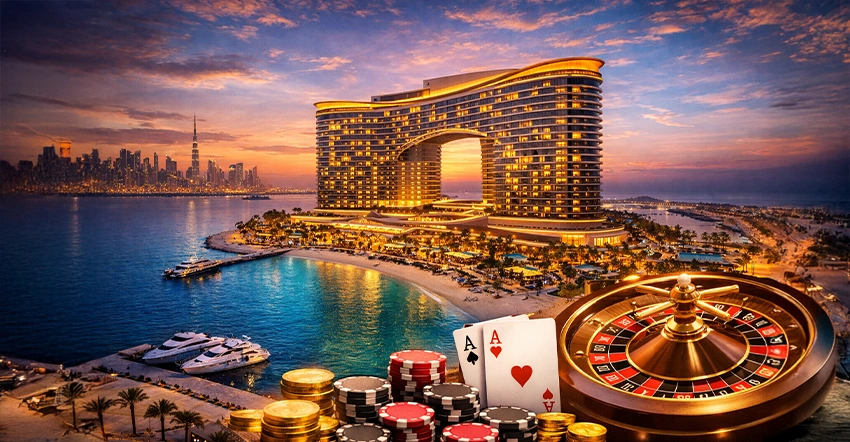
Dubai Casino: Wynn Al Marjan & the Future of Casinos in the Emirates
Why Dubai Casino Could Redefine the UAE?
For years, the phrase Dubai Casino has lived more in search engines than in reality. Travelers, investors, and gaming industry observers have long associated Dubai with luxury hotels, spectacular nightlife, world-class shopping, and headline-making architecture, yet not with regulated casino gaming.
That is now beginning to change across the wider UAE landscape, and the project accelerating that conversation is Wynn Al Marjan Island in Ras Al Khaimah, which is currently slated to open in early 2027. Wynn has described it as the first integrated gaming resort in the MENA region, and the UAE’s federal gaming regulator lists Wynn Al Marjan among its licensed land-based gaming facilities.
This matters not only for Ras Al Khaimah, but for the global perception of the Emirates as a whole. When people search for Dubai Casino, they are often really asking a bigger question: Can the UAE become a premium gaming and entertainment destination on the same level as Las Vegas, Singapore, or Macau?
From today’s vantage point, the answer looks increasingly positive. The UAE already has the aviation infrastructure, the hospitality DNA, the luxury positioning, and the international audience. Dubai alone welcomed 19.59 million international overnight visitors in 2025, its third consecutive record year, showing how powerful its tourism engine already is even before casino gaming becomes part of the wider destination story.
Wynn Al Marjan Casino Is Changing the Conversation
The most defining development in the region’s evolving entertainment landscape is the rise of Wynn Al Marjan Island. Developed in partnership with Marjan and RAK Hospitality Holding, this landmark resort is taking shape on the shores of Ras Al Khaimah and is currently expected to open in early 2027. With major construction milestones already achieved, Wynn continues to present the property as one of its most ambitious international projects, reflecting the scale of its long-term vision for the UAE.
Just as important is the formal regulatory structure now established at the federal level. The creation of the General Commercial Gaming Regulatory Authority signals a clear shift toward a licensed and supervised commercial gaming environment in the Emirates. With Wynn Al Marjan publicly listed among the approved land-based gaming licensees, the project has moved well beyond speculation. It now stands as a concrete, regulated development with the potential to redefine regional hospitality.
For observers following the wider Dubai Casino conversation, this is the real turning point. The first major breakthrough is not happening in Dubai itself, but in Ras Al Khaimah. Even so, the influence of Wynn Al Marjan is likely to be felt across the entire UAE. From a branding, tourism, and international visibility perspective, its opening could significantly reshape how the world views the Emirates as a future hub for luxury entertainment and integrated resort experiences.
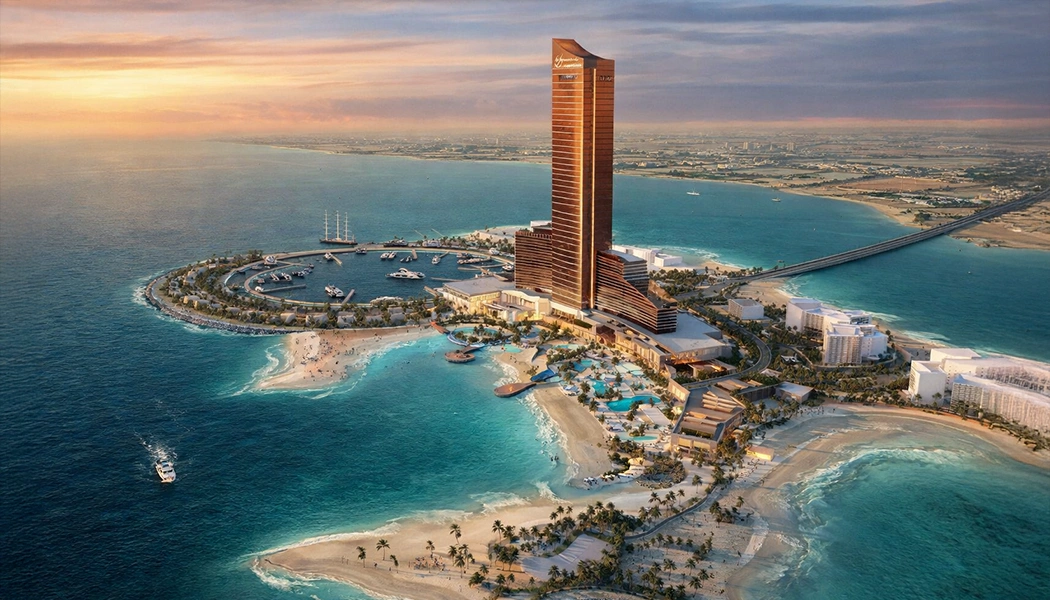
Wynn Al Marjan Casino Ressort concept image
The Positive Impact Wynn Al Marjan Could Generate
A development of this magnitude does far more than attract attention. It creates real momentum across multiple sectors and helps reposition the UAE within the global entertainment and hospitality conversation.
The first impact is tourism. Ras Al Khaimah already recorded a strong performance in 2024, with rising visitor numbers, growing tourism revenue, and increasing demand from the events and business travel segment. In that context, Wynn Al Marjan arrives at exactly the right moment. As a flagship project, it has the potential to elevate the emirate’s international profile and reinforce the wider appeal of the UAE for travelers already exploring luxury hospitality, entertainment, and even topics related to the evolving Dubai Casino landscape.
The second effect is on hospitality. Wynn is not developing a standalone gaming venue, but a true integrated resort in the most premium sense of the term. This is the kind of model that has already proven successful in destinations such as Las Vegas and Singapore.
The project is designed as a complete lifestyle destination, with high-end accommodation, refined dining, curated experiences, and a strong sense of architectural identity. Its appeal goes well beyond gaming alone, which is precisely why it can attract a broad international audience, including visitors who may first engage with the destination through entertainment content, resort experiences, or even online interest in free casino games before seeking a more immersive luxury environment in real life.
The third major benefit lies in employment and economic diversification. Projects of this scale generate value long before opening day. Recruitment activity, supplier ecosystems, training needs, logistics, transport, food and beverage, events, technology, and premium services all begin to expand around such a development. Wynn Al Marjan therefore represents more than a resort launch; it is a catalyst for long-term economic activity and a meaningful addition to the UAE’s broader diversification strategy.
Finally, there is the image and positioning effect for the country as a whole. A destination does not need a large number of resorts to change how it is perceived internationally. In many cases, one iconic project is enough to signal a new era. Just as landmark integrated resorts helped redefine other global destinations, Wynn Al Marjan has the potential to do the same for the Gulf. It sends a strong message that the UAE is entering a new phase of luxury, regulation, and world-class entertainment, with implications that will naturally extend to the broader conversation around premium travel, resort gaming, and the future of the Dubai Casino market.
Could Dubai Become the Next Las Vegas?
In one important sense, Dubai is already closer to Las Vegas than many people might think. Not because it has traditionally been a gaming destination, but because it already understands the broader formula behind world-class entertainment and luxury travel.
Las Vegas built its global status by bringing together hotels, restaurants, live shows, conventions, shopping, nightlife, and spectacle into one unified visitor economy. Dubai has already mastered most of that model. It is one of the world’s leading cities for luxury hospitality, high-end dining, major events, premium retail, and iconic architecture. Its tourism performance confirms that scale: with 19.59 million international overnight visitors in 2025, Dubai is not an emerging destination, but an already dominant international hub. That strength is one reason why the city is increasingly mentioned in wider discussions around the future of luxury entertainment, integrated resorts, and the type of experience travelers often associate with the Best rated Casinos worldwide.
What Dubai has historically lacked is the gaming element itself. Wynn Al Marjan does not instantly transform Dubai into Las Vegas, and it remains important to keep the legal reality clear. The first major breakthrough is taking place in Ras Al Khaimah, not in Dubai itself, which means the immediate momentum is centered elsewhere in the UAE. Even so, growing international interest in topics such as Dubai Casino and premium resort gaming shows how closely the region is now being watched.
The broader strategic opportunity, however, is highly compelling. If the UAE successfully launches a tightly regulated integrated resort model in Ras Al Khaimah, Dubai could benefit enormously as the country’s best-known gateway, luxury capital, and stopover destination. Rather than copying the classic Las Vegas model, Dubai can evolve into its own premium entertainment hub, where hospitality, aviation, gastronomy, beach resorts, retail, and upscale leisure all work together. In that ecosystem, digital discovery also plays a role, as many international users first engage with gaming-related content through resort research, destination guides, or even online interest in free casino games before expanding toward broader entertainment experiences.
That is why the idea of the UAE becoming the “next Las Vegas” should not be interpreted too literally. The more accurate view is that Dubai and the wider Emirates have the ingredients to build a new kind of integrated resort ecosystem—one driven by luxury, international appeal, and carefully regulated expansion. In many ways, that could become even more powerful than simply replicating an existing model.
The UAE’s Next Great Entertainment Era
What was once seen as a distant possibility is now becoming a credible and exciting evolution for the UAE’s tourism landscape. With Wynn Al Marjan Island in Ras Al Khaimah expected to open in early 2027, the region is moving closer to a new model of luxury entertainment that could bring meaningful benefits in terms of tourism growth, job creation, hospitality expansion, international visibility, and investor confidence.
While Dubai itself does not currently host a casino resort, its role remains central. The city already offers global appeal, exceptional infrastructure, and a powerful reputation for premium travel experiences. That makes it a natural gateway for visitors discovering this new chapter in the Emirates, especially as nearby destinations expand their high-end leisure and entertainment offerings.
What makes this moment so compelling is not the idea of replicating Las Vegas, but the opportunity to build something distinctively Emirati: a modern destination where luxury, lifestyle, hospitality, and entertainment come together in a way that feels ambitious, international, and forward-looking.
 Published On: January 12, 2026